Splunk Competitors: Which SIEM and Log Management Alternatives Make Sense in 2026?
Technical review by Volodymyr Garbar, CISO & Tech Lead
Updated: 16 October 2026
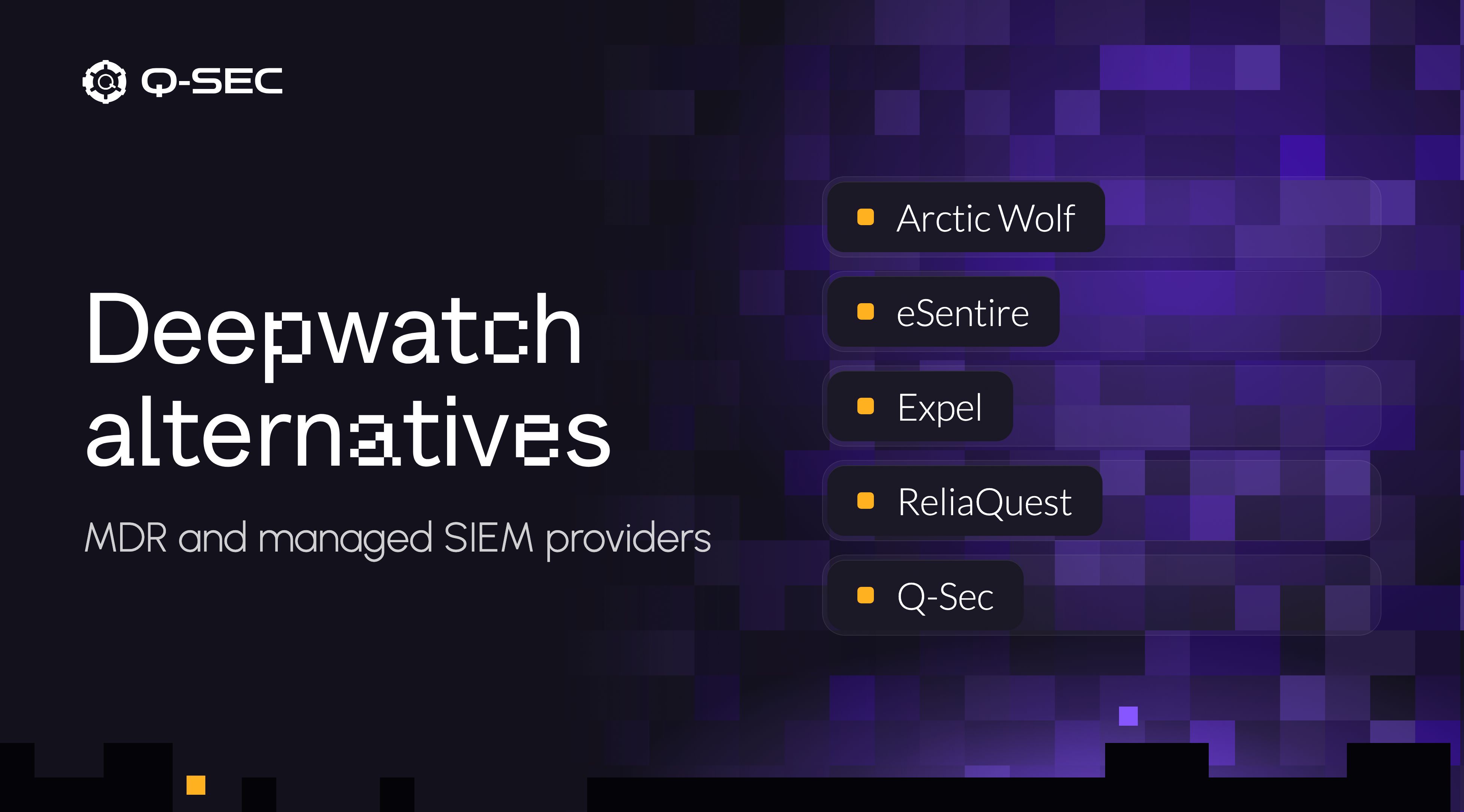
ReliaQuest competitors include Expel, eSentire, Arctic Wolf, and other managed security operations providers. Q-Sec is also worth considering for European organizations looking for continuous detection, investigation, and hands-on incident response. The main difference is how these providers combine security technology, automation, human analysts, and responsibility for responding to threats.
ReliaQuest is an interesting company to compare because its GreyMatter platform has moved well beyond the traditional MDR model. It now brings together security tools, threat detection, exposure management, automated investigations, and AI agents that can carry out security operations tasks.
For a large organization with a complicated security stack, that approach has obvious appeal. ReliaQuest promises to connect the tools a company already owns and make them work together more effectively.
But not every organization needs that level of platform investment. Some need an external security team to run day-to-day operations. Others already have a capable SOC and want better automation. And some need a provider that can take responsibility for incidents without adding another major technology project.
Those are quite different requirements, even if they all appear in the same MDR procurement shortlist.
Looking for an alternative to ReliaQuest?
Q-Sec Advanced Detection & Response combines 24/7 security operations, daily threat hunting, and hands-on incident response while working with your existing security technologies.
ReliaQuest competitors at a glance
The main ReliaQuest alternatives approach security operations differently. Some focus on managed detection and response, while others place more emphasis on platform automation, ongoing security guidance, or direct operational support.
| Provider | Main approach | Best fit |
|---|---|---|
| ReliaQuest | GreyMatter platform with agentic AI, threat detection, and security operations automation | Organizations with complex security stacks and established SecOps requirements |
| Expel | MDR across existing tools with transparent investigations | Teams wanting managed detection with visibility into analyst work |
| eSentire | Atlas-powered MDR, threat hunting, and incident response | Organizations looking for comprehensive managed threat detection and response |
| Arctic Wolf | Aurora MDR with Concierge Security Team | Organizations wanting continuous security operations and ongoing security guidance |
| Q-Sec | Managed SOC and Advanced Detection & Response | European organizations seeking hands-on investigation, containment, and operational security support |
This is a comparison of operating models, rather than a ranking. ReliaQuest's platform capabilities are not identical to a managed SOC contract, and buyers should be clear about which parts of GreyMatter they actually need to replace.
What does ReliaQuest GreyMatter provide?
ReliaQuest GreyMatter is an AI-powered security operations platform that connects existing security technologies and automates threat detection, investigation, response, and related SecOps workflows.
ReliaQuest describes GreyMatter as an agentic AI security operations platform. It brings together data and actions from different security technologies, allowing security teams to investigate threats and execute response workflows across their environment.
The platform currently emphasizes several capabilities:
- Threat detection and response: Correlating security signals, investigating suspicious activity, and executing response playbooks.
- Agentic AI security operations: AI agents that perform tasks involving investigations, detection engineering, threat hunting, intelligence, and other security workflows.
- Existing technology integration: Connecting SIEM, EDR, cloud, identity, and other security products rather than requiring customers to replace everything.
- Exposure management: Bringing asset and vulnerability context into security operations to help prioritize threats.
- Security operations visibility: Providing a common environment for investigations, automation, and operational reporting.
ReliaQuest's GreyMatter platform currently advertises integrations with more than 300 technologies. Its AI capabilities are a major part of the company's positioning, particularly the automation of work traditionally performed by Tier 1 and Tier 2 SOC analysts.
This makes ReliaQuest different from a basic MDR service that primarily monitors alerts and escalates incidents.
But it also changes the buying decision.
If you already have a well-staffed SOC, GreyMatter may help your team handle more work with the tools it already uses. If you have no internal SOC, your first concern may be who will investigate and contain threats every night.
GreyMatter can support both kinds of security operations, but the required service scope and commercial arrangement may differ considerably.
Why do organizations look for ReliaQuest alternatives?
Organizations look for ReliaQuest alternatives when they want a different balance between security automation, managed services, operational complexity, response ownership, and cost.
GreyMatter has substantial capabilities, particularly for organizations managing multiple security technologies. Still, there are several reasons another provider may be a better fit.
The organization needs a managed security team more than another platform
An organization with a mature SOC may benefit from GreyMatter's cross-platform automation and AI-assisted workflows.
A mid-sized business with a small IT department faces a different problem.
It may already own Microsoft Defender, a SIEM, and several security tools. What it lacks is the capacity to investigate incidents, maintain detections, hunt for threats, and respond outside business hours.
In that situation, the first priority is finding a provider that will perform the work.
The underlying technology matters, of course. But the customer is primarily buying operational responsibility.
The security environment is relatively straightforward
GreyMatter is designed to connect complex security environments and coordinate work across multiple tools.
For an organization with a smaller or more standardized security stack, a conventional MDR service may cover the necessary detection and response requirements without introducing the same breadth of platform functionality.
That does not automatically make the alternative cheaper or easier. The integration and service scope still need to be compared.
But there is little value in purchasing capabilities the team has no practical use for.
The organization wants a different approach to automation
ReliaQuest is investing heavily in agentic AI, including autonomous investigation and response capabilities.
That can reduce repetitive work, but buyers should understand how the automation operates.
Which actions can AI agents perform independently? When does a human analyst review the investigation? How are incorrect decisions identified? Can the customer restrict certain response actions?
These are particularly important questions when automation can disable accounts, isolate endpoints, or modify security configurations.
A provider using more analyst-led workflows may suit an organization that prefers greater human involvement in sensitive decisions.
Service delivery and contractual responsibilities need to change
Sometimes the technology is working well enough, but the service arrangement is not.
The customer may need different response authority, clearer escalation procedures, more predictable pricing, or stronger support for regional reporting requirements.
Those problems should be documented before evaluating replacements. Otherwise, the organization risks purchasing a different platform while keeping the same operational frustrations.
Which ReliaQuest competitors are worth considering?
Expel, eSentire, Arctic Wolf, and Q-Sec are relevant ReliaQuest alternatives for organizations evaluating MDR and managed security operations. Each offers a different combination of technology, analyst expertise, and operational responsibility.
Expel: MDR built around your existing security tools
Expel is one of the closest alternatives for organizations that want to retain their security stack.
Its MDR service connects to existing technologies through Expel Workbench, bringing together security signals and investigations. Automation and AI support the investigation process, while human analysts handle security decisions and response.
Expel places considerable emphasis on transparency. Customers can see investigation details, response actions, and analyst activity rather than receiving only a completed incident ticket.
That matters for organizations with internal security teams that want to understand how their external provider reaches decisions.
Where Expel may be a better fit: Organizations that want MDR with detailed investigation visibility, broad technology integration, and close collaboration between internal and external analysts.
What to check: Compare supported integrations, response permissions, detection engineering, and the operational work Expel will perform. ReliaQuest also offers extensive integrations and investigation automation, so the difference needs to be demonstrated in your environment.
eSentire: managed detection and response with Atlas
eSentire is a direct competitor in managed detection and response.
Its Atlas platform supports continuous threat detection, investigation, threat hunting, and incident response across multiple security signals.
eSentire also operates security operations centers, including one in Cork, Ireland, which makes it relevant for European organizations evaluating regional service delivery.
The company's approach combines technology with dedicated security operations and threat-response expertise.
Where eSentire may be a better fit: Organizations looking for a managed MDR service with broad detection coverage, established threat-hunting capabilities, and incident-response support.
What to check: Compare Atlas with GreyMatter for existing tool integrations, analyst responsibilities, investigation workflows, and containment authority.
eSentire is not a lightweight alternative simply because ReliaQuest has invested more heavily in agentic AI. Both offer substantial security operations capabilities, and the useful distinction is how the service operates for your organization.
Arctic Wolf: MDR with a dedicated security team
Arctic Wolf approaches managed detection and response through its Aurora platform and Concierge Security Team model.
The service combines continuous monitoring and response with ongoing security guidance from a team familiar with the customer's environment.
This relationship can be particularly useful for organizations that need external security expertise beyond incident investigation.
For example, a business may want help identifying recurring weaknesses, improving detection coverage, and prioritizing security improvements alongside its MDR service.
Where Arctic Wolf may be a better fit: Organizations that want a managed security relationship with regular guidance and support for improving their security posture.
What to check: Understand which response actions are included, what the Concierge team handles, and how the service works with your existing tools.
ReliaQuest also provides security expertise and customer support, so this is not a comparison between having specialists and having none. The difference is the working relationship and the responsibilities agreed with the provider.
Q-Sec: managed security operations with hands-on response
Q-Sec offers Advanced Detection & Response, a managed security service combining continuous monitoring, human-led investigation, proactive threat hunting, and incident response.
Q-Sec's ADR service works with existing EDR, SIEM, cloud, identity, and other security telemetry. Its analysts investigate verified threats and can execute or guide containment actions within the agreed response scope.
The service includes daily targeted threat hunting, threat intelligence, forensics, and post-incident analysis. Incident response is built into ADR rather than treated as a completely separate service.
For European organizations, Q-Sec also provides managed SOC and compliance-related services that can support operational requirements under frameworks such as NIS2 and DORA.
Where Q-Sec may be a better fit: Organizations that want an external team to handle detection, investigation, and response, particularly when they already have security tools but limited internal operational capacity.
What to check: Establish whether ADR or broader Q-SOC coverage is required, which integrations are supported, and what containment and remediation actions Q-Sec can perform.
Q-Sec is a managed security alternative, although it does not offer a direct software replacement for every GreyMatter capability. Organizations seeking GreyMatter's specific agentic AI platform functions should evaluate that difference carefully.
ReliaQuest vs. traditional MDR: What is the difference?
ReliaQuest GreyMatter places greater emphasis on cross-platform security automation and agentic AI, while traditional MDR focuses on providing continuous detection, investigation, and response as a managed service. In practice, the distinction is less rigid because many MDR providers now offer advanced automation, threat hunting, and integration with existing security tools.
ReliaQuest itself has increasingly positioned GreyMatter as an alternative to conventional MDR arrangements.
Its argument is that security teams need to move beyond monitoring and responding to individual alerts. They need better coordination between tools, automated investigation, and the ability to act quickly across the environment.
There is a reasonable case for that approach, especially in large organizations where analysts spend significant time switching between products and manually gathering evidence.
But MDR has changed too.
Providers such as Expel, eSentire, and Arctic Wolf use automation and AI in their services. Q-Sec's ADR combines automation with analyst-led investigation and hands-on response.
The practical distinction is how the customer wants security operations delivered.
A company with its own SOC may prefer a platform that gives its analysts more automation and control. A company without a SOC may prefer a provider that takes responsibility for the operational work.
Both approaches can be effective. The wrong choice is the one that leaves important work without an owner.
Is ReliaQuest better than Expel?
ReliaQuest may be a better fit for organizations seeking broad SecOps automation through GreyMatter, while Expel may appeal to teams that prioritize transparent managed investigations and close integration with their existing security tools.
Both providers emphasize technology integration and reducing manual analyst work.
ReliaQuest's current direction centers on GreyMatter's agentic AI capabilities, including automated investigation, detection engineering, threat hunting, and response workflows.
Expel combines automation with human analysts through Workbench and provides customers with detailed visibility into investigations.
The choice becomes clearer when both providers demonstrate the same incident.
Take a compromised administrator account that has accessed several cloud systems. Ask how each service correlates identity and endpoint signals, establishes the scope of the incident, determines the appropriate response, and documents the actions taken.
Pay particular attention to the decisions made automatically and those requiring analyst or customer approval.
That will tell you considerably more than a comparison of AI feature counts.
Can ReliaQuest replace an internal SOC?
ReliaQuest can reduce the workload of an internal SOC and provide managed security operations capabilities, but whether it can replace an internal team depends on the contracted service and responsibilities retained by the customer.
GreyMatter can automate many tasks that would otherwise require analyst time, including investigation, detection engineering, and response workflows.
ReliaQuest also offers security operations expertise and services around its platform.
However, organizations still need clear ownership of security governance, risk decisions, access permissions, incident coordination, and other internal responsibilities.
For a business deciding between ReliaQuest and an outsourced SOC, the important question is how much operational work will remain with its own employees.
That includes routine tasks such as detection tuning and integration maintenance, as well as incident handling when something goes wrong.
An organization that wants an external team to run security operations should compare the actual service scope with providers offering managed SOC or MDR.
Q-Sec's SOC-as-a-Service, for example, is designed around continuous monitoring, investigation, response, and security operations delivered by an external team.
Is ReliaQuest suitable for European organizations?
Yes. ReliaQuest can be considered by European organizations, but buyers should assess its data-processing arrangements, operational delivery, response responsibilities, and contractual support for applicable regulations.
European organizations have some additional considerations when selecting a managed security provider.
A company subject to NIS2 may need evidence of incident handling, appropriate cybersecurity risk-management measures, and clear processes for escalating potentially reportable incidents.
A financial entity subject to DORA may also need specific contractual arrangements for ICT services, incident documentation, and operational resilience.
These requirements affect how the provider's service fits into the organization's security program.
NIS2 and incident-response evidence
The NIS2 Directive establishes cybersecurity risk management and incident reporting obligations for covered entities.
Security monitoring and incident response can support several of those requirements, particularly detection, investigation, containment, and maintaining evidence of security incidents.
When comparing ReliaQuest with MDR providers, check what information the organization receives after an incident.
A useful record should explain what happened, when it was detected, which systems were affected, what actions were taken, and what remains unresolved.
It should also be possible to provide relevant information to the people responsible for regulatory reporting.
MDR or GreyMatter cannot establish NIS2 compliance by itself. The organization remains responsible for its applicable obligations, including measures outside security monitoring.
For a closer look at the role of managed detection and response, see MDR for NIS2.
DORA and operational resilience
The Digital Operational Resilience Act applies to covered financial entities and includes requirements involving ICT risk management, incident management and reporting, resilience testing, and ICT third-party risk.
Security operations providers can contribute to threat detection, incident investigation, containment, and maintaining operational evidence.
But the financial entity still needs to understand the provider's responsibilities, dependencies, subcontracting arrangements, and role in incident coordination.
For organizations evaluating ReliaQuest alternatives, these details should be addressed during procurement rather than after an incident.
Data processing and security operations
European buyers should also review where security telemetry is processed, who can access it, and how long investigation records are retained.
The same questions apply to AI-driven security operations.
If an AI agent investigates an incident using information from several connected systems, the organization should understand which data is accessed, where processing occurs, what actions are permitted, and how those actions are recorded.
These are reasonable questions for every provider using security automation, not a concern unique to ReliaQuest.
How much does ReliaQuest cost compared with competitors?
ReliaQuest does not publish a standard public price list for GreyMatter, so organizations need a customized quote based on their environment, platform capabilities, integrations, and service requirements.
The same is true for many enterprise MDR and managed SOC arrangements.
A direct price comparison can be difficult because providers package their capabilities differently.
ReliaQuest may be evaluated as a security operations platform with associated services. Other providers may price managed detection and response around monitored assets, technology coverage, data sources, or service packages.
The cost of the provider is only one part of the calculation.
A company should also consider the technology it needs to retain, the work performed by internal analysts, and any additional incident-response or engineering services.
Before comparing proposals, establish a common scope:
- Systems and security technologies covered by the service.
- Number of endpoints, identities, cloud workloads, and other monitored assets.
- Integration, onboarding, and detection-engineering requirements.
- Threat hunting and analyst investigation coverage.
- Automation and response capabilities included in the agreement.
- Incident containment, remediation, and forensic support.
- Log storage, retention, and potential additional charges.
- Internal staffing requirements and ongoing service management.
For organizations comparing managed services, Q-Sec's Cybersecurity Pricing in Europe guide provides MDR and SOC pricing references, common cost drivers, and questions to ask before signing.
The important part is comparing equivalent operational responsibilities.
A platform that reduces internal analyst work may justify a higher subscription. A managed service may be more economical for a company that would otherwise need to recruit several security specialists.
The answer depends on what the organization already has and what it expects the provider to handle.
What should you check before replacing ReliaQuest?
Before replacing ReliaQuest, determine which GreyMatter capabilities your organization uses and whether the alternative can provide the same security coverage and operational outcomes.
This matters because GreyMatter combines several functions that may be delivered separately by other providers.
For example, an organization may use ReliaQuest for automated investigations, threat hunting, exposure context, detection engineering, and response workflows.
Moving to a conventional MDR service may preserve monitoring and incident response while changing how the other functions are delivered.
That could be perfectly acceptable. But the difference needs to be understood before the contract is signed.
A practical evaluation should cover five areas.
1. Detection coverage
Confirm which data sources the new provider will monitor and whether important detections depend on GreyMatter-specific integrations or workflows.
2. Response authority
Establish which actions the provider can execute, which require approval, and what happens when internal contacts are unavailable.
3. Automation and analyst responsibilities
Determine which investigations and response tasks are automated, where human analysts are involved, and how the customer can review decisions.
4. Migration requirements
Document existing detection rules, integrations, response playbooks, investigation records, and reporting processes.
A transition should include a period of validation to avoid losing security visibility.
5. Operational ownership
Make sure every recurring task has an owner after the migration.
That includes detection maintenance, integration failures, incident investigation, remediation, and reporting.
Security teams sometimes discover that a provider's service ends at the point where their most difficult internal work begins. It is worth finding that out during evaluation.
Which ReliaQuest competitor should you choose?
The right ReliaQuest competitor depends on whether your organization needs a security operations platform, a managed detection and response provider, or a team to take responsibility for ongoing security operations.
- ReliaQuest remains a strong option for organizations that want to coordinate complex security environments through GreyMatter and make extensive use of agentic AI automation.
- Expel deserves consideration when transparent investigations and working with existing security tools are priorities.
- eSentire is relevant for organizations seeking broad MDR coverage, threat hunting, and established incident-response capabilities.
- Arctic Wolf may appeal to businesses that want regular security guidance alongside managed detection and response.
- Q-Sec is an option for European organizations that need continuous security monitoring, proactive hunting, and hands-on response delivered as a managed service.
None of these choices should be made solely on the number of integrations, AI agents, or advertised response-time figures.
What matters is whether the provider can detect threats in your environment, investigate them properly, take the agreed actions, and leave your team with a clear understanding of what happened.
Comparing ReliaQuest with a managed security operations provider?
Talk to Q-Sec about your existing security stack, response requirements, and how ADR or Q-SOC could fit your environment.
Frequently asked questions
Who are ReliaQuest's main competitors?
ReliaQuest competitors include Expel, eSentire, Arctic Wolf, and other security operations providers. Q-Sec is also a managed security alternative for European organizations. The right choice depends on platform requirements, MDR coverage, automation, and response responsibilities.
What are the best ReliaQuest GreyMatter alternatives?
Expel, eSentire, and Arctic Wolf are worth evaluating for managed detection and response. Q-Sec offers managed SOC and ADR services. However, none should be assumed to replace every GreyMatter platform capability.
Is ReliaQuest an MDR provider?
ReliaQuest offers managed security operations capabilities, but its current GreyMatter positioning extends beyond traditional MDR into agentic AI, security automation, threat hunting, detection engineering, and exposure management.
Does ReliaQuest work with existing security tools?
Yes. GreyMatter integrates with hundreds of security technologies, including SIEM, EDR, cloud, and other systems. Buyers should verify the specific integrations and response capabilities needed in their environment.
Can Q-Sec replace ReliaQuest?
Q-Sec can provide an alternative for managed detection, threat hunting, incident response, and SOC operations. It is not a direct replacement for every GreyMatter software capability, so buyers should compare their actual requirements.
Can ReliaQuest or its competitors help with NIS2?
Yes. Security operations providers can support detection, incident response, and evidence collection relevant to NIS2. However, the organization remains responsible for its applicable cybersecurity and reporting obligations.
Author: Q-Sec Security Operations Center
Oct 16, 2026, 1:13:39 PM
Oct 16, 2026, 1:13:39 PM