How to Conduct a PCI DSS Risk Assessment
Payment processing security is the work of protecting payment account data and the systems that handle or can affect a card transaction, from the moment a customer enters card details through authorization, settlement, storage, support, and later use. PCI DSS is the main security baseline for that environment, but the practical job is wider than passing an assessment.
A payment flow can be short on a diagram and still involve a surprising number of systems: the checkout page, browser scripts, APIs, payment gateways, processors, cloud services, identity platforms, logs, support tools, fraud systems, and third parties. The first security job is simply knowing which of those systems can see payment data or change what happens to it.
That matters even when payment collection is outsourced. PCI SSC says merchants that outsource all payment processing still retain responsibilities around the provider relationship and their own validation path. Outsourcing can reduce scope. It does not make the merchant disappear from the payment-security picture.
Payment processing security at a glance
The easiest way to think about payment security is to follow the transaction and ask what could expose account data, change the payment flow, or weaken the controls around it. This table keeps the main areas in one place.
| Area | What can go wrong | Security focus |
| Checkout and payment page | Skimming, injected scripts, fake forms, unsafe redirects | Payment-page control, script authorization, integrity, change detection, secure development |
| Payment APIs and gateways | Weak authentication, exposed secrets, insecure integration, misrouting | Strong authentication, least privilege, secret handling, API security, change control |
| Stored account data | Unnecessary PAN storage, weak protection, exposed backups or exports | Data minimization, tokenization, encryption, key control, retention and deletion |
| User and admin access | Stolen credentials, shared accounts, excessive privilege | Unique identities, MFA, access review, privileged-access control |
| Systems around the CDE | Unpatched software, malware, weak segmentation, missing logs | Vulnerability management, monitoring, segmentation, testing, secure configuration |
| Processors and other providers | Unclear responsibility, expired evidence, unmanaged dependencies | Due diligence, contracts, responsibility mapping, annual status monitoring |
For the regulation-level view of PCI DSS scope, validation, and the full requirement set, start with our PCI DSS requirements guide. This page stays focused on the payment flow and the controls around it.
What does payment processing security actually cover?
It covers more than the card number. PCI SSC defines cardholder data as the primary account number (PAN), plus cardholder name, expiration date, and service code when those elements appear with the PAN. Sensitive authentication data includes full track data, card verification codes, and PINs or PIN blocks.
One rule is especially easy to get wrong: PCI SSC states that sensitive authentication data must not be stored after authorization, even if it is encrypted. If a team has a reason to keep CVV "for support" or "just in case," the design needs to change rather than the wording in the policy.
The security boundary also includes systems that may never store PAN themselves. A web server that can alter a checkout page, an identity platform used by CDE administrators, a logging system receiving sensitive fields, or a third-party service with access into the environment can all matter because they can affect the security of payment account data.
If that boundary is still fuzzy, our What Is the CDE in PCI DSS? guide explains the cardholder data environment, connected-to systems, and security-impacting components in more detail.
Where does card data travel during a payment?
The exact path depends on the payment model, but a useful map starts at the customer and follows the data until the transaction is authorized and any required records are retained. For e-commerce, that may mean browser, merchant site, payment page, gateway or processor, acquiring path, payment network, and issuer. Card-present environments add terminals, local networks, point-of-sale systems, and sometimes store servers or management platforms.
The map should include more than the "happy path." Refunds, recurring payments, customer support, reconciliation, chargeback handling, fraud review, logs, backups, exports, analytics, and developer test environments can create their own copies of payment data. A system that was out of scope during checkout can become very interesting once someone exports a CSV into it.
This is why data-flow work is not busywork for an assessor. It is often where the team finds the system nobody remembered, the third-party integration that changed six months ago, or the logging field that contains more than expected.
What are the biggest security problems in payment processing?
Most failures are not exotic. They are usually ordinary security weaknesses placed next to valuable payment data: credentials that are too powerful, an old plugin, a script nobody owns, a processor integration copied from an old project, a flat network, or logs that exist but nobody watches.
The risk also changes by payment channel. A stolen point-of-sale credential is a different problem from malicious JavaScript in a browser. A compromised API key can bypass controls that would stop a user at the login screen. A third-party payment service can be well run and still leave the merchant with responsibilities that were never assigned internally.
PCI DSS helps because it forces those ordinary pieces into a defined control structure. It does not make architecture decisions for the business. The team still has to decide where card data should exist, which systems really need access, and which complexity can be removed.
How does PCI DSS fit into payment processing security?
PCI DSS v4.0.1 is the current PCI DSS version supported by PCI SSC. The Council describes it as a baseline of technical and operational requirements for entities that store, process, or transmit cardholder data or sensitive authentication data, and for entities that can affect the security of the cardholder data environment.
The official PCI DSS standard page lists merchants, processors, acquirers, issuers, and service providers among the intended audience. That is useful because payment processing security is shared across an ecosystem, but the responsibilities are not automatically shared evenly.
A processor may operate the authorization platform. A cloud provider may operate infrastructure. A merchant may own the checkout code, user identities, integrations, and support process. Another vendor may manage fraud tooling. PCI DSS does not allow those boundaries to stay vague. Someone needs to know which requirement is performed by which party and what evidence proves it.
Does outsourcing payment processing remove PCI DSS responsibilities?
No. It can reduce the number of requirements that touch the merchant environment, and that can be a very good design choice, but the merchant still has responsibilities.
PCI SSC's current FAQ on outsourced payment processing says merchants remain responsible for making sure the provider is appropriate for the services used, maintaining required agreements, monitoring provider compliance status at least annually, understanding shared responsibilities, and following the applicable validation path.
This is where teams sometimes over-read a provider's Attestation of Compliance. An AOC can be valuable evidence, but it answers a defined question about the provider's assessed services and scope. It does not say that the merchant's integration, configuration, access model, website, or surrounding systems are automatically compliant.
For the assessment side of that decision, see our PCI DSS audit and assessment guide. It explains SAQs, ROCs, AOCs, assessor roles, and the difference between readiness work and formal validation.
How should e-commerce payment pages be secured?
For e-commerce, the customer's browser has become part of the security discussion. A payment page can be compromised without an attacker first breaking into the processor. If malicious code reaches the page or the merchant site changes where the customer is sent, card data can be exposed before the normal payment controls get a chance to help.
PCI DSS v4.0.1 Requirements 6.4.3 and 11.6.1 address this problem for applicable environments. PCI SSC's 2025 Payment Page Security and Preventing E-Skimming guidance explains the two jobs plainly: manage and authorize payment-page scripts, protect script integrity, and detect unauthorized changes to payment pages and security-impacting HTTP headers as received by the consumer browser.
There is a nuance for SAQ A merchants. PCI SSC removed Requirements 6.4.3 and 11.6.1 from the SAQ A questionnaire effective 31 March 2025, but added an eligibility criterion requiring the merchant to confirm that its site is not susceptible to script attacks that could affect the e-commerce system. The underlying PCI DSS requirements still exist in the standard. The reporting path and the security problem are not the same thing.
PCI SSC's SAQ A script-security FAQ gives two practical routes: the merchant can use suitable techniques itself, or obtain confirmation from the PCI DSS compliant payment provider that its embedded payment solution includes protections against script attacks when implemented as instructed.
Should a merchant store card data at all?
Often the better security decision is to store less. Every retained PAN creates a longer-lived protection problem: access control, encryption or another approved method of rendering it unreadable, key management, backups, retention, deletion, logging, support access, and assessment evidence.
Tokenization can help by replacing PAN with a token that is not useful as payment account data on its own. Encryption protects data differently. Neither technique should be treated as a magic scope switch because the vault, keys, de-tokenization path, clear-text access, and connected systems still matter.
Our PCI DSS tokenization and encryption guide covers that decision in detail, including what stays in scope and why encrypted PAN does not automatically become out of scope.
What supporting controls matter around the payment flow?
Payment processing does not sit in its own little security universe. The surrounding controls decide whether an attacker can reach the transaction path, change it, or stay there unnoticed.
Identity is one example. Admin access to payment applications, cloud consoles, e-commerce platforms, gateways, CI/CD, and security tooling needs strong authentication and controlled privilege. Our PCI DSS password and authentication guide explains the current Requirement 8 rules and MFA boundaries.
Logging is another. A payment incident is much harder to investigate when the team cannot trace admin activity, authentication, changes, or security events. The PCI DSS Requirement 10 guide covers logging, review, alerting, retention, and the evidence behind those controls.
Then there is vulnerability management. Payment systems still need patches, scans, secure configuration, and remediation. The PCI DSS vulnerability scanning and management guide separates internal scanning, external ASV scanning, vulnerability remediation, and the work that belongs to penetration testing.
Cloud environments add another ownership layer. If payment services, storage, APIs, or supporting systems run in AWS, Azure, GCP, or SaaS platforms, our PCI DSS Cloud Computing guide explains shared responsibility and provider evidence without assuming that a compliant provider makes the customer environment compliant.
When should the payment environment be penetration tested?
Scanning and penetration testing answer different questions. A scanner is good at finding known weaknesses. A penetration test asks whether real attack paths can be used to cross boundaries, reach sensitive systems, bypass controls, or exploit application and network weaknesses in the defined scope.
For PCI DSS, Requirement 11.4 owns the penetration-testing requirements. Scope can include external and internal paths, application-layer weaknesses, segmentation controls, and testing after significant changes where the requirement applies. The important part for payment teams is to scope from the actual data flow and attack paths rather than from a list of IP addresses someone used last year.
For the detailed Requirement 11.4 rules, use our PCI DSS penetration testing requirements guide.
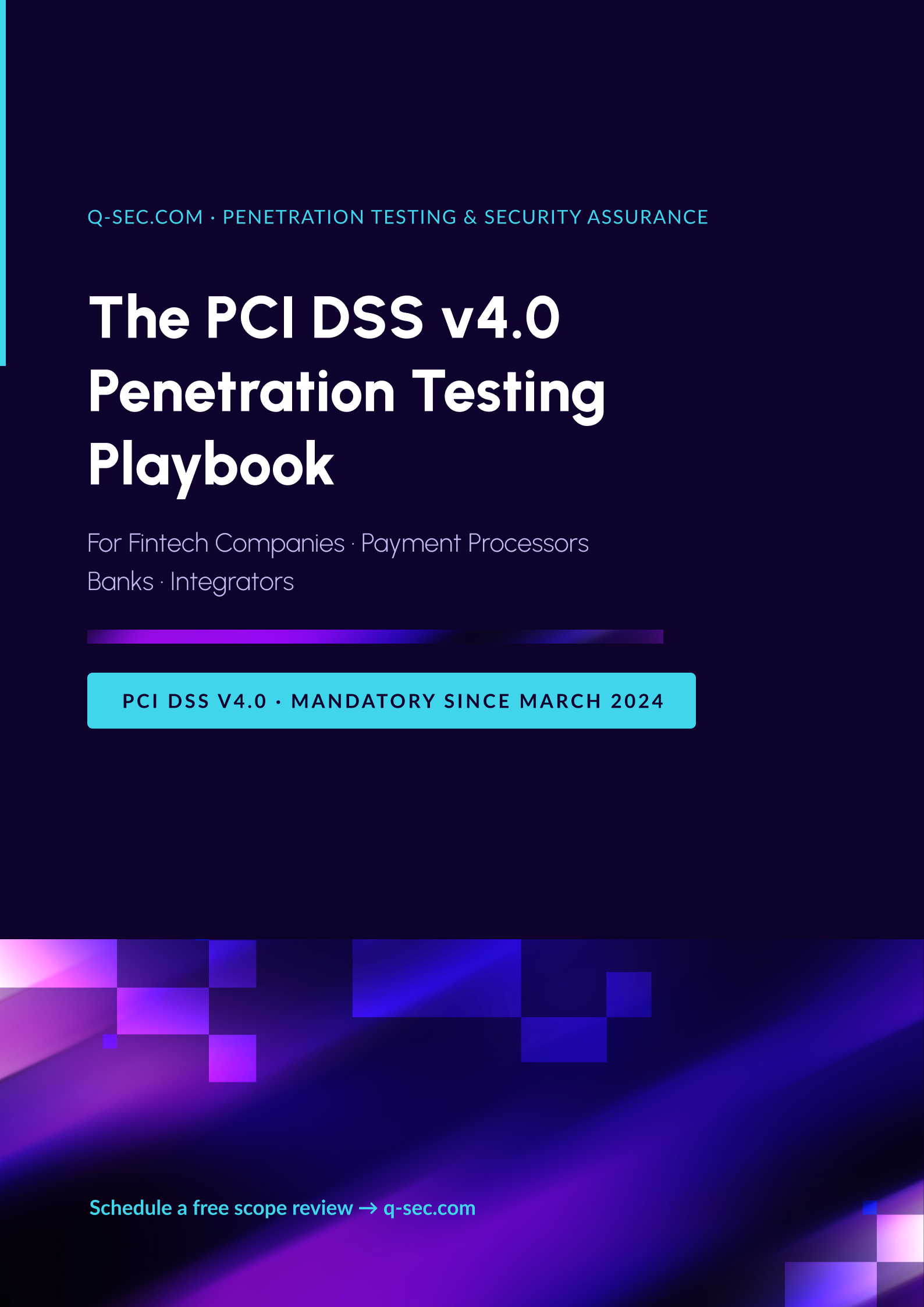
Free guide
Test the payment environment against the paths that matter
Use the playbook to define Requirement 11.4 scope, prepare payment applications and connected systems, and collect evidence that is useful during the assessment cycle.
Get the PCI DSS Penetration Testing PlaybookHow should third-party payment providers be managed?
Start with a responsibility map, not a logo page that says "PCI compliant." The map should identify the service, the payment function it performs, the systems or data it can affect, which PCI DSS requirements it performs for the customer, which responsibilities stay with the customer, and the evidence available for each side.
PCI SSC's third-party service provider FAQ says customers must manage and oversee TPSP relationships, perform due diligence, maintain appropriate agreements, identify the requirement split, and monitor provider PCI DSS compliance status at least annually.
The awkward part is that providers change. Services get renamed, products move between platforms, account configurations drift, contracts renew, and integrations are replaced. A responsibility matrix that was accurate at onboarding can become fiction surprisingly quickly. Provider evidence and the actual architecture need to be reviewed together.
A practical payment processing security workflow
There is no single architecture that fits every merchant or processor, but the work usually gets much clearer when the team follows the payment flow instead of starting with a control spreadsheet.
- Draw the real payment-data flow. Include checkout, processor handoff, recurring payments, refunds, support, fraud tools, logs, backups, exports, and third parties. Mark where PAN and SAD can appear.
- Remove data and access you do not need. Outsource collection where it makes sense, stop storing unnecessary PAN, remove stale exports, and narrow administrative access before adding more controls around avoidable exposure.
- Define the CDE and connected systems. Use connectivity, access, security impact, and data flow. Do not scope only the database that stores card data.
- Assign every control to an owner. For each internal team and provider, record what they operate, what they prove, and what remains with the customer.
- Protect the transaction path. Secure the payment page, scripts, APIs, credentials, secrets, configuration, and network boundaries. Treat browser-side code as part of the attack surface.
- Keep the surrounding systems healthy. Patch, scan, monitor, review logs, control privileged access, test segmentation, and make sure evidence is retained long enough to be useful.
- Test the paths that could reach payment data. Use vulnerability scanning for known weaknesses and penetration testing for attack paths and control effectiveness where PCI DSS requires it.
- Review the design when the payment model changes. A new processor, checkout plugin, cloud service, mobile flow, support tool, or analytics integration can change scope even when nobody calls it a PCI project.
What should a security team be able to prove?
A secure payment flow should leave evidence behind. The exact set depends on the environment and validation route, but a team should be able to show how scope was defined, who owns each control, what the providers cover, how access is restricted, how systems are patched and scanned, how payment pages are protected, how events are monitored, and how findings are closed.
That evidence does two jobs. It helps the assessor, but it also helps the team notice when the operating reality no longer matches the diagram. If the only person who knows why a gateway is configured a certain way leaves the company, the control was never as mature as the spreadsheet suggested.
For the assessment workflow and the difference between readiness evidence, SAQ, ROC, and AOC, see our PCI DSS Audit and Assessment guide.
Final thoughts: secure the transaction, not just the form
A payment form can look perfectly normal while the real weakness sits somewhere else: an admin account, a browser script, an old API integration, a logging gap, a vendor relationship, or a database export created for a one-off business request and then forgotten.
The useful question is not "Are payments PCI compliant?" It is more concrete: where can account data appear, which systems can change or reach that path, who owns each control, and what evidence shows that the controls still work today? Once those answers are clear, PCI DSS becomes much easier to operate as part of normal security work rather than a yearly scramble.
Turn payment security into a workable PCI DSS program
Q-Sec supports PCI DSS readiness, scope and evidence work, remediation planning, penetration testing coordination, and ongoing security controls.
Frequently asked questions about payment processing security
These are the questions teams usually ask once payment security moves from a diagram into real systems and provider contracts.
What is payment processing security?
It is the protection of payment account data and the systems that collect, transmit, process, store, or can affect a card transaction. That includes checkout pages, APIs, processors, identities, logs, cloud services, terminals, and third parties.
If a payment processor handles all card data, do we still have PCI DSS responsibilities?
Usually yes. Outsourcing can reduce the merchant's technical scope, but PCI SSC still expects provider oversight, responsibility mapping, appropriate agreements, annual status monitoring, and the applicable validation route.
Can we store CVV if it is encrypted?
No. PCI SSC states that sensitive authentication data such as card verification codes must not be stored after authorization, even if encrypted.
Does tokenization remove PCI DSS scope?
It can reduce scope, but not automatically. The token vault, de-tokenization path, systems that can retrieve PAN, and security-impacting connections still need to be considered.
Does using a hosted payment page make our website out of scope?
Not automatically. A hosted or embedded payment solution can reduce exposure, but the merchant site may still affect payment security. SAQ A also includes an eligibility condition around protection from script-based attacks.
Do payment-page scripts need security controls under PCI DSS v4.0.1?
For environments where Requirements 6.4.3 and 11.6.1 apply, yes. PCI SSC focuses on script authorization, integrity, inventory and change or tamper detection. SAQ A has a separate reporting nuance, but the security problem remains.
What evidence should we keep for payment processing security?
Keep scope and data-flow records, responsibility maps, provider evidence, access reviews, configuration and patch records, scans, test reports, log-review evidence, payment-page controls, remediation records, and the validation documents that apply to your environment.