How to Conduct a PCI DSS Risk Assessment
PCI DSS does not have one official compliance price. The PCI Security Standards Council sets the standard and assessor programs, but it does not publish a price list for what a merchant or service provider should pay for its own assessment, scanning, penetration testing, remediation, or internal compliance work.
The real cost comes from the environment. A small payment setup with a narrow cardholder data environment can be very different from a service provider running a large cloud platform, several payment flows, old systems, and a full Report on Compliance. The validation route matters too, but scope is usually where the budget starts moving.
It helps to separate the bill into a few parts: validation and assessor work, required security testing, remediation, technology or architecture changes, and the internal time needed to keep evidence current. Some of those costs are external invoices. Others are engineering and compliance hours that never appear on a QSA quote.
PCI DSS compliance cost at a glance
As a rough 2026 market reference, published PCI DSS pricing ranges from a few hundred dollars per year for very small, simple compliance programs to roughly $16,000–$18,000 for a straightforward QSA assessment, $45,000–$75,000 for a basic Level 1 audit, and $100,000–$250,000+ for complex enterprise environments.
There is no single PCI DSS compliance price, though. The final cost depends heavily on scope, validation route, testing requirements, remediation needs, and the amount of internal work required to prepare and maintain evidence.
| Cost area | What you may need | What makes it grow |
| Scope and scoping work | CDE mapping, data-flow review, connected systems, third parties | More payment flows, flat networks, shared services, cloud accounts, unclear ownership |
| Validation | SAQ or ROC work, AOC, assessor support where required | ROC/QSA route, complex scope, multiple entities, poor evidence quality |
| External scanning | ASV scans where Requirement 11.3.2.1 applies | More public IPs, repeated failures, remediation and rescans |
| Penetration testing | Internal/external testing, segmentation testing where applicable | Large attack surface, complex segmentation, retesting, cloud/hybrid scope |
| Remediation | Patching, MFA, logging, segmentation, secure configuration, application changes | Legacy systems, technical debt, unsupported software, missing controls |
| Evidence and operations | Policies, logs, tickets, reviews, screenshots, ownership records | Manual processes, scattered evidence, unclear owners, late preparation |
| Third parties and cloud | AOCs, responsibility mapping, contracts, provider evidence | Many providers, unclear shared responsibility, services affecting the CDE |
Why is there no fixed PCI DSS compliance price?
Because PCI DSS compliance is not one product. The Council manages the security standard and qualification programs, while payment brands and acquirers manage compliance-validation programs. They decide how a merchant or service provider must validate and report compliance, including whether the result is documented through a Self-Assessment Questionnaire or a Report on Compliance.
PCI SSC explains this split in FAQ 1473: compliance-accepting entities determine validation and reporting methods, while assessors validate scope and applicability during an assessment.
That is also why a price from one company cannot be treated as a universal PCI rate. QSA companies, ASVs, penetration-testing firms, consultants, and technology providers set their own commercial fees. PCI SSC publishes fees that QSA companies pay for qualification and training, but those are assessor-program fees, not a merchant price list for a PCI DSS assessment.
If you see the phrase "PCI DSS certification cost," be careful with the wording. PCI SSC says it does not recognize a general PCI DSS compliance certificate. Official validation documentation includes SAQs, ROCs, AOCs, and approved scan forms. See PCI SSC FAQ 1220.
How much does a scope change in PCI DSS cost?
A lot. Scope determines how many systems, people, processes, payment flows, cloud services, and third parties have to be assessed and supported with evidence. If the scope is wrong, almost every later estimate is wrong with it.
A business that outsources most payment processing and keeps card data away from its own systems may have a much smaller assessment surface than a payment processor that stores PANs, runs its own payment APIs, supports multiple tenants, and connects the CDE to shared identity, logging, CI/CD, or cloud services.
For the scope boundary itself, see our PCI DSS CDE guide. It explains the cardholder data environment, connected-to systems, security-impacting systems, segmentation, and the cases where "we do not store card numbers" is not enough to keep a system out of scope.
Architecture decisions can also change future cost. Tokenization, well-designed segmentation, and outsourcing selected payment functions can reduce exposure when implemented correctly. They do not remove PCI DSS responsibility by themselves, and they can create new third-party and evidence work.
Our PCI DSS tokenization and encryption guide explains where tokenization may reduce scope and where token vaults, de-tokenization paths, encryption keys, and systems that can recover PAN remain important.
How does the validation route affect cost?
The difference between a self-assessment route and an independent assessment is one of the clearest budget changes, but the organization should not choose the route just because it is cheaper.
PCI SSC says merchants should confirm their validation requirements with the acquirer or payment brand, while service providers should contact the payment brands. FAQ 1126 covers the independent-assessment versus self-assessment question.
An SAQ-eligible environment can avoid some external assessment cost, but it still needs the controls, the evidence, and any required scanning or testing. An ROC engagement usually involves much more assessor time because the scope, control operation, evidence, interviews, and testing have to be examined and documented in detail.
The PCI DSS audit and assessment guide goes deeper into SAQs, ROCs, AOCs, evidence review, remediation, and the difference between readiness support and formal validation.
What scanning and testing costs should be in the budget?
PCI DSS has recurring technical work that can generate direct vendor cost even after the initial project is finished. The exact set depends on the environment and applicable requirements.
For external vulnerability scanning, PCI DSS Requirement 11.3.2.1 requires quarterly scans by a PCI SSC Approved Scanning Vendor where that requirement applies. PCI SSC also makes clear that a passing ASV scan is evidence for that scanning requirement, not proof of overall PCI DSS compliance. PCI SSC FAQ 1234 explains the boundary.
The price can rise when the public attack surface is large, scans fail repeatedly, or the organization has to fix findings and rescan before it gets a passing result. Internal scanning creates work too, even when it is handled by the internal security team rather than a vendor.
Our PCI DSS vulnerability scanning and vulnerability management guide covers internal scans, ASV scans, remediation, rescanning, patching, and the evidence that has to survive assessment review.
Penetration testing is a separate line item. Where Requirement 11.4 applies, the engagement can include internal and external testing, segmentation testing, retesting after remediation, and testing after significant changes. The cost moves with the number of systems, applications, APIs, networks, cloud environments, and segmentation paths in scope.
For the testing side, see our PCI DSS penetration testing guide and the practical playbook below.
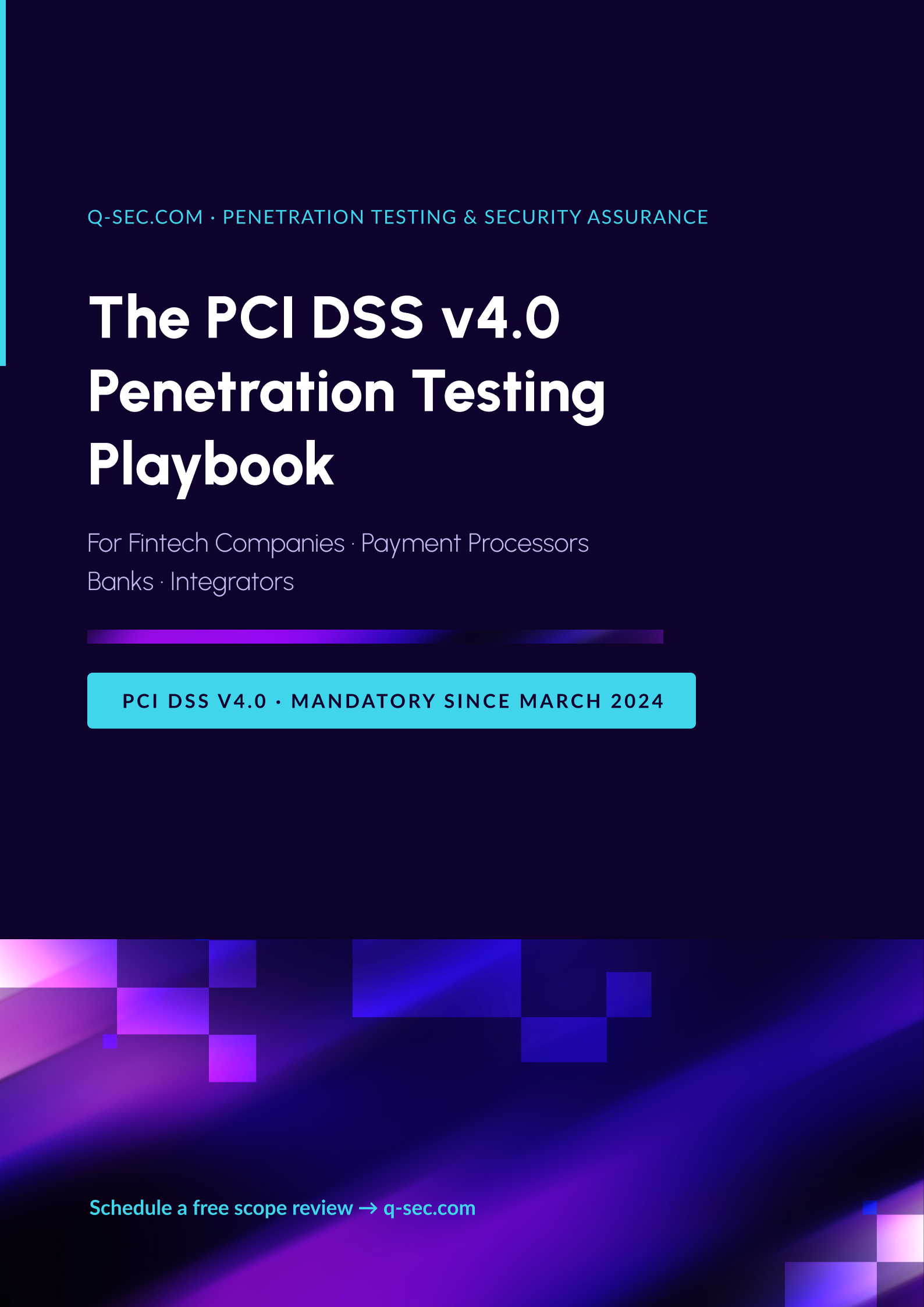
Free guide
Budget the testing work before it becomes a surprise
Use the playbook to scope Requirement 11.4 testing, prepare evidence, understand segmentation testing, and see what needs to be ready before the engagement starts.
Get the PCI DSS Penetration Testing PlaybookWhy can remediation cost more than the assessment?
Because the assessor is often telling you about work the environment already needed. A quote for assessment support can be predictable. The engineering effort behind a weak identity model, missing logging, old payment applications, flat network design, unsupported systems, or poor key management is harder to estimate before the gaps are known.
This is where a cheap assessment can still turn into an expensive PCI project. If the first serious scope review happens late, the team may discover systems that were never budgeted for, evidence that was never retained, or controls that exist in policy but not in the environment.
The opposite is true too. A mature environment with clear ownership, working access controls, reliable logging, routine vulnerability management, and clean third-party evidence usually spends less time reconstructing proof during the assessment.
Do cloud and third-party providers reduce PCI DSS cost?
Sometimes. Outsourcing can reduce the amount of payment infrastructure you operate yourself, but it does not make provider oversight disappear. The organization still has to know which services are in scope, obtain the right compliance evidence, and document who is responsible for each applicable requirement.
A cloud provider with a current AOC can remove some infrastructure work from your side, but the customer configuration, identities, applications, logging, data flows, and shared-responsibility controls can still be yours. Our PCI DSS cloud computing guide explains that split in more detail.
This matters for budgeting because a low-cost provider decision can create expensive internal work later if the contract, service boundary, or evidence package does not support the PCI assessment.
What internal PCI DSS costs are easy to miss?
The internal time is easy to underestimate because nobody sends an invoice for it. Someone still has to answer assessor questions, collect evidence, chase owners, review third-party documents, schedule scans, coordinate testing, track remediation, and keep the program alive after the assessment closes.
Typical internal cost shows up in security, infrastructure, engineering, compliance, procurement, legal, and business teams. If evidence is scattered across tickets, inboxes, dashboards, and personal folders, the same control can consume hours every time somebody asks for proof.
Is PCI DSS compliance a one-time cost?
No. The assessment may have an annual cycle, but many PCI DSS activities happen throughout the year. Vulnerability scanning, log review, access management, patching, control reviews, targeted risk analyses, penetration testing, third-party oversight, and evidence retention all create recurring work.
PCI SSC also does not define one universal reassessment schedule for every entity. How often validation is required and how long an assessment result is accepted are determined by the organizations that manage compliance programs, such as payment brands and acquirers.
PCI SSC FAQ 1565 explains that retiring a standard version does not itself change the validity period of an assessment result; the compliance program determines the reporting cycle.
A useful budget therefore separates the initial readiness project from recurring operating cost. Otherwise year two looks cheaper on paper until the first ASV scan, pen test, evidence refresh, or control change arrives.
How should you compare PCI DSS quotes?
Ask what is actually inside the quote. Two proposals with the same headline price can cover very different work.
- Scope assumptions: Which entities, locations, payment channels, cloud accounts, applications, networks, and third parties are included?
- Validation deliverable: Is the work readiness support, SAQ assistance, a formal ROC assessment, AOC preparation, or coordination with an independent QSA?
- Scanning: Are ASV scans included? Are rescans included after remediation?
- Penetration testing: Is Requirement 11.4 testing included, and does the scope cover internal, external, application/API, and segmentation testing where applicable?
- Remediation: Does the provider only report gaps, or help the team fix them? How are retests or follow-up reviews priced?
- Evidence support: Will the team map requirements to evidence, review artifacts before assessment, and help resolve assessor questions?
- Third-party review: Is AOC and responsibility-matrix review included for cloud and payment providers?
- Change control: What happens if the scope grows after discovery? Get the commercial rule in writing rather than assuming the first quote is fixed.
If a quote is much cheaper than the others, the useful question is not "why are the others expensive?" It is "which work is missing from this one?" Sometimes the answer is completely reasonable. Sometimes the quote covers assessment only and leaves testing, remediation, evidence preparation, or QSA coordination outside the price.
How can an organization reduce PCI DSS cost without weakening the program?
The sustainable savings usually come from reducing unnecessary scope and repeated manual work, not from skipping required controls.
- Keep card data out of systems that do not need it. Payment architecture decisions made early can be cheaper than trying to secure a sprawling CDE later.
- Use segmentation where it has a real design and testing case. Segmentation can reduce scope, but only if the boundary is understood and maintained.
- Automate evidence where it makes sense. A reliable system export is cheaper than rebuilding the same proof by hand every assessment cycle.
- Fix recurring findings at the source. Paying for the same remediation and retest every year is usually more expensive than correcting the underlying process.
- Confirm the validation route before buying assessment work. Do not pay for a project based on assumptions that the acquirer or payment brand later rejects.
- Prepare before the assessor arrives. Clean scope records, owners, evidence, third-party AOCs, scan results, and open-gap tracking reduce avoidable assessment back-and-forth.
Final thoughts: A useful PCI DSS budget starts with scope, not a market average
There is no PCI SSC number that tells a company what PCI DSS "should cost." A useful estimate starts with the payment architecture, CDE, validation route, recurring testing, known gaps, third-party dependencies, and the internal people who will maintain the evidence.
Once those pieces are visible, pricing becomes much easier to compare. You can see which costs are mandatory work, which are remediation choices, and which come from avoidable complexity in the environment.
Get a PCI DSS scope and readiness plan you can actually budget
Q-Sec can help map the PCI DSS scope, identify readiness gaps, coordinate technical remediation and testing, and prepare the evidence needed for assessment and validation.
Frequently asked questions about PCI DSS compliance cost
How much does PCI DSS compliance cost?
Published 2026 pricing examples range from a few hundred dollars per year for very small compliance programs to $100,000–$250,000+ for complex enterprise assessments. The actual cost depends on scope, validation route, testing, remediation, and internal compliance work.
Does PCI SSC set the price for a QSA assessment?
No. PCI SSC qualifies QSA companies and publishes program fees paid by assessors, but commercial assessment fees are set by the QSA company.
Is an SAQ cheaper than a ROC?
Usually the external assessment effort is lower, but only eligible organizations can use an SAQ route. Your acquirer or payment brand determines the required validation and reporting method.
What is PCI DSS certification cost?
PCI SSC does not recognize a general PCI DSS compliance certificate. Use the official validation route and documentation required by your acquirer or payment brand, such as an SAQ, ROC, or AOC.
Are ASV scans included in PCI DSS assessment cost?
Not automatically. ASV scanning is a separate service unless the proposal explicitly includes it. Check whether recurring scans and rescans after remediation are covered.
Does penetration testing add to PCI DSS cost?
Yes when Requirement 11.4 testing is in scope and delivered by an external tester. Price depends on the attack surface, segmentation, applications, networks, cloud systems, and retesting.
Can tokenization lower PCI DSS compliance cost?
It can reduce scope when the design genuinely removes systems from exposure to cardholder data. The tokenization system, de-tokenization paths, and related controls can still remain in scope.
Why does PCI DSS get more expensive after the first assessment starts?
Usually because scoping or remediation was underestimated. Newly discovered systems, missing evidence, old technology, weak segmentation, or unresolved findings can add work that was not visible in the first quote.